Mini reviews of Television seasons old and new. No fuss. No spoilers. Occasional bunnies.
Showing posts with label B. Show all posts

Tuesday, June 28, 2016

The Box of Delights (1984)

TBoD is much-loved by many people. I suspect that some part of the warm feelings that accompany thoughts of the series is to do with similar feelings toward the holiday season in which it's always shown; i.e. the lead up to Christmas. I'm not implying that to love TBoD you need also to love Christmas, but there's a definite correlation there. As such, while I very much enjoy what it does on a technical level, the 'seasonal magic' is merely perfunctory for me.

I apologise if it seems like I'm treading on someone's childhood when I say that the story was frequently uneven, losing ground in the middle section before pulling it back for an exciting ending that was itself followed by what I'd consider a clichéd cop out if it wasn't for the slight ambiguity that lingers as the credits roll.

The story revolves around eleven-year-old schoolboy Kay Harker (Devin Stanfield), travelling home for the holidays. His adventure begins before he's even stepped off the train, and it moves to the next level when he bumps into a bearded Patrick Troughton (both pictured above), an encounter that changes the course of his winter break. The box, more like a box of tricks than one of delights, is sought by a number of unscrupulous people who'll do almost anything to retrieve it. Kay and his friends must do their best to help keep it from their lupine hands.

The young actors are all fine, but the danger level never reaches the heights that were needed to keep me fully engaged with their plight. But I admit that I sometimes find it difficult to relate to privileged rich kids.

It will likely appeal to fans of the BBC's more well-publicised adaptation of C.S. Lewis' The Lion, the Witch and the Wardrobe (1988), which it predates by four years. (The original novel by John Masefield also predates Lewis' Narnia books. The Box of Delights was published in 1935, whereas The Lion, the Witch, and the Wardrobe didn't appear until 1950. I've not read Masefield's book.)

The 'technical' aspects I mentioned above are used to enable the magical properties of the box to be realised. The effects are a mixture of practical, chroma key, suit actors and hand drawn animation. The latter was my favourite - the scenes of animals running, flying, etc, through various environments are beautiful.

6 episodes, approx 30 minutes each (I really liked the episode titles).

3 hobsessions out of 5

Friday, January 1, 2016

Bad Influence! (1992-96)

My first thought was, 'Who let Andy Crane out of the broom cupboard?', but he did an okay job on his feet, showing an admirable amount of enthusiasm in the presenter role. His co-host of the show is Violet Berlin, which is a name that most UK folks who were into gaming back in the 90s will recognise.

It wasn't as good as the similarly themed GamesMaster (1992-98) series that aired on a rival channel, but Bad Influence!'s focus was broader.

It states on Wiki that the show was like a 'Tomorrow's World' for kids, which is an observation I agree with. Of course, it means nothing if you don't already know what kind of a show Tomorrow's World was. In both cases, new technology that was either still under development, in the testing phase or already on the market was showcased in an easy to understand way that didn't compromise the scientific nature or importance of the product. Features were either in the studio or on location and showed the presenter(s) getting hands-on with the new tech.

The techy stuff was cool, but the main focus was Video Games, Consoles and Home Computers. By 1992 the 16 bit consoles had taken a strong hold, but CD-based options were appearing. It's fun to look back and see how things like the Panasonic branded '3DO Interactive Multiplayer' and the 'Phillips CD-i' were heralded as the next big thing, when in fact they were the next big failures.

Interestingly, product reviews even included third-party devices, such as the kind that enabled gamers to circumvent copy protection on cartridges, allowing for import carts to be played on UK machines. The friendly warning that the use of such gray area products voided your warranty seemed more like a necessary addition to keep the team on the right side of the law than anything else.

The competitions were mostly amazing; in one episode they even gave away a Neo Geo with games! In the UK at the time, a Neo Geo was like the Holy Grail - in fact, it was better, because you can't play Metal Slug on the Holy Grail.

57 episodes, approx 20 minutes each.

3 super-fast datablasts out of 5

Wednesday, February 25, 2015

Blackeyes (1989)

Apologies for the blurry picture used above, but in some ways it emphasises a point about the availability of Dennis Potter’s 'Blackeyes' miniseries: no proper box art exists because it's been denied a commercial release. It's been hidden away in the BBC vaults for twenty-six years. An image search returns precious little other than a bootleg DVD and the covers of Potter’s original novel (1987) to work with, hence my crude cut-n-paste job from a VHS copy.

The story's typical of the author's work, which is to say it's a complex arrangement of layers presented in an unconventional, creative manner; a non-linear narrative that ebbs and flows; a sensual tide that takes as much as it gives.

The titular character is a representation of a writer’s fascination with his niece’s past profession, unattainable except in fiction. He takes parts from her time as a fashion model and creates a tragic, self-reflective, male fantasy that walks off the page. She's a sullied depiction of reality whose very existence taunts.

Her blank slate personality is being written and rewritten by more than one author at any one time, from various perspectives, including, but not limited to, ownership and revenge. Some of the character types are lifted piecemeal from other genres, further blurring the lines between what’s written and real, what’s imagined and what’s being or has already been lived. Nothing is simple.

The unseen narrator—the voice that critiques even itself—is the voice of Potter, uncredited in the role, but inherent, more than just a passive element in his own fairytale playground. The shifting voyeuristic and intimate commentaries are by turns enlightening and disturbing, but always controversial.

Potter was also the director, so the camera is his eye, a part of the space it helped create, moving god-like through it and inside of it. In that, he also excels.

Many critics of the era panned it. The need to label it as either misogynist or satirically damning of misogyny placed them on an uncomfortable fence. Perhaps they recognised elements of themselves in it or it highlighted their own slavish failings? It's even possible that the dislike was unconsciously fuelled by a sociopolitical consciousness change that was happening at the time. But most likely—in not having the benefit of hindsight that we have now—they simply didn't understand it. That's nothing of which to be ashamed. Achieving complete understanding isn't a prerequisite for viewing. I suspect Potter is the only one who ever really could've comprehended every daring facet of it.

4 episodes, approx 50 minutes each.

4 tangles of prose memories out of 5

Wednesday, September 17, 2014

Batman Beyond: Complete Series (1999-2001)

aka Batman of the Future

The team that created Batman Beyond achieved the near-impossible: they made a show that's the equal of Batman: The Animated Series (1992-95) and they did it without having Bruce Wayne as the lead! Holy Personnel Changes, Batman.

It's set in 2039, forty years after TAS' successor, The New Batman Adventures (1997-97), and continues the continuity set up by both it and TAS. The era of the original crusader has passed. The world has moved on. Gotham has evolved into Neo-Gotham, a towering, high-tech megalopolis wherein the crime and corruption is as rife in the shiny office buildings as it is on the late night docks. Bruce (Kevin Conroy) is still around, possibly because, like one of his contemporaries said, he's too stubborn to die. He is, however, a retired, cranky and cynical recluse that rarely leaves the Manor.

Enter Terry McGinnis (Will Friedle), a seventeen-year-old high school student with a criminal record. Terry has the kind of family upbringing that was denied Bruce, but they have something in common nonetheless: they share a similarly strong moral belief and a desire to see justice carried out. When Terry takes up the mantle he becomes both the symbol that teaches and the student. Bruce, through a two way communication device in the new bat suit, gives advice and support, but it's Terry that takes the weight (and the punches and kicks, etc).

The show references the past in many ways. One of which is the biker gang that terrorises the city and its citizens. They're like a cross between the typical garden variety thug and the Clowns from Akira (1988). They're the painted-faced Jokerz, styled after the original Joker that caused Bruce grief decades before.*

It'll occasionally go further and build an entire episode around something from the past, but never as a means to milk old glories or hide failings. Instead, it's a knowing nod to TAS fans, because BB stands firm on its own two (rocket) feet.

Alongside the criminal of the week it introduces a new roster of regular villains and madmen, some more memorable than others. My personal favourites are the tricky Spellbinder (Jon Cypher), the mysterious Inque (Shannon Kenny), and the clumsy but dangerous anarchist Mad Stan (Henry Rollins).

52 episodes, approx 22 minutes each, split over 3 seasons.

5 critical lifesaving clues out of 5

*There's a feature length entry titled Return of the Joker (2000) that's a must-see for fans of both BB and TAS. If possible seek out the uncut version.

Sunday, June 1, 2014

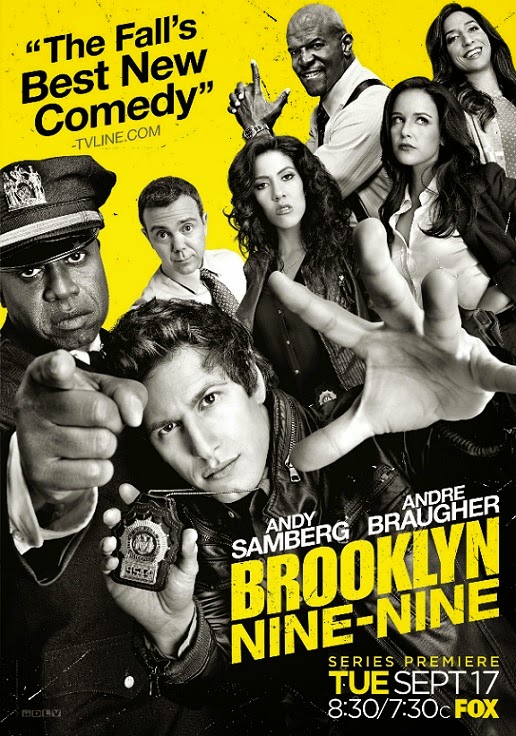
Brooklyn Nine Nine (2013)

"I'm super glad you're here right now. Are you smelling that weed smell? Cuz a dude broke in, smoked weed and bolted."
"Do you think it's the same dude who left that bong there on the floor?"
"...yes?"
Police are not new to being TV show fodder, but it is rather rare to have the comedic version rather than a drama one especially with all the CSI's and Law and Order's out there. Even more rare that it is actually funny and entertaining. Brooklyn Nine Nine follows the detectives of the 99th precinct as they go through the idiosyncrasies of the NYPD while dealing with each other. Andy Samberg plays the main character Det. Jake Peralta who despite being a great detective is regularly dealing with the consequences of his crippling debt and man-child tendencies that irk his new, almost robotic Captain Holt played expertly by Andre Braugher. There is also his partner Det. Amy Santiago who is always out to prove herself and creepily latches onto the Captain as her would-be mentor. There is also Det. Rosa Diaz, who frequently scares everyone around her, cops and criminals alike. And there is Sgt. Terry Jeffords who would be a great cop if he wasn't plagued by crippling anxiety about police work since becoming a father.

It is quite hilarious as they go solve cases while clashing with each other as much as the criminals. All the characters are well realized and get more so as the season moves along. This adds good gravitas and endearing traits to the characters and their relationships in addition to the comedy which makes for a much more watchable show and only increases the surprise that more people aren't watching it. The episodes are also pretty self contained which means perfect for syndication which may be what some executive is going for as that means more money. An overarching plot doesn't really present itself until the end and it is then only set up as a launching point for season 2. Stellar writing, acting, and comic delivery.

Buyer's Guide:
Available streaming on Hulu, Amazon, Google Play, etc.

4 graffiti penises on minivans out of 5

Monday, December 9, 2013

Blackadder: The Specials (1988 - 1999)

I'm not going to go into every detail about this volume, because it's the weakest entry in the series and will be of very little interest to most people. It's damn expensive to buy singly, so, for the completists who already own Series I–IV, if you must have it your best option is to double-dip and get The Complete Collection Box Set for a fraction of the price.

Firstly, Blackadder's Christmas Carol. It's the Dickens classic given a comedy makeover, featuring some of the best comedic talent in Britain at the time. It's longer than a typical episode. It was a joy to see Robbie Coltrane doing comedy again. He's good at it. What more can I say? Stuff it in your gift sock.

The Cavalier Years is an interesting addition. It's set in 1648, during the English Civil War. It's very similar to Blackadder II. If you picture Lord Edmund with a shaggy-perm wig you'll be close to the mark. It was part of Comic Relief's Red Nose Day in 1988 and is sadly only half the length of a regular episode. It's good that it's a standalone because, while it could've certainly worked as a series, it's much too similar to what came before.

The remainder of the disc is less than impressive. I'll mention Blackadder: Back and Forth because it's presented as the 'final episode in the saga,' but the less said about it the better because it's a piss-poor effort. Rowan Atkinson tries his best but it feels as if everyone else is merely going through the motions for old-times sake. It was a disappointing end to an otherwise great series.

2½ buggered giddy aunts out of 5

Sunday, December 8, 2013

Blackadder Goes Forth (1989)

In some ways it's business as usual, but in other ways the fourth incarnation is very different. I can't say why without going into spoiler territory, but I'm confident you'll come to the same kind of conclusions if you watch it.

It's set in 1917. Edmund and his companions occupy a WWI trench on the Western Front. They're all a little stir crazy. Edmund being Edmund means he'd rather be elsewhere doing other things, anything, and so spends the entire time trying to achieve that seemingly impossible goal.

It's a kind of reunion of past cast members, each given a military rank. Besides Captain Blackader there's Private S. Baldrick (Tony Robinson); Lieutenant George (Hugh Laurie); Captain Darling (Tim McInnerny); General Melchett (Stephen Fry); and a few more cameos. Fry gets some of the best lines. I'm amazed he managed to deliver many of them without breaking down into hysterics.

While Blackadder II remains my personal favourite, there's no doubt that IV has better production. The sets are more believable and the costumes are beautifully made. It feels less like a comedy sketch show with a tacked on plot and more like an actual sit-com with real, lasting consequences. The actors fit their roles perfectly. The individual episodes are better scripted and the satire is arguably more relevant to our time. The last episode in particular deserves high praise.

6 episodes, approx 30 minutes each.

4 of the best, trousers down out of 5

Friday, December 6, 2013

Blackadder the Third (1987)

The third incarnation of Blackadder jumped forward to the years leading up to the British Regency period (sometime in the late 18th or early 19th Century), making Edmund the personal butler of the Prince of Wales.

The cast was lessened considerably, to just four regulars, and to compensate the dialogue was given even more importance. There seems to have been a conscious effort to make almost every word of Edmund's have some hilarious snide or sarcastic humour attached to it. He really is an acerbic git.

Baldrick is as important to the show's structure as Blackadder himself, so it's no surprise to see him return.

We finally get to see Mrs Miggins, who, no disrespect to actress Helen Atkinson-Wood, was the only new addition that felt de trop. The character simply didn't get anything noteworthy to do.

The final regular is the son of King George III, the Prince Regent who's also called George, played by Hugh Laurie. Laurie is a natural born comedian. He's utterly believable as the epitome of the thick-as-shit, silver spoon-fed toff; he even managed to make Baldrick look relatively smart.

The Royal setting again enabled critique of the upper class and the monarchy, both of whom deserve all they get. Hurrah!

6 episodes, approx 30 minutes each.

3½ turnips out of 5

Thursday, December 5, 2013

Blackadder II (1986)

After the disappointing first series, I'm surprised that Blackadder II ever got the green light, but it did and I'm very glad. Ben Elton joined Richard Curtis on writing duties, which helped matters considerably. Ben was no stranger to cheap alternative comedy having worked on The Young Ones a few years before. The BBC put restrictions on the production, but the two men managed to turn them to their advantage.

It's set in England during the Elizabethan era (1558–1603). The new Blackadder is a descendent of the original Black Adder. That means he can have different characteristics and a different personality. Elizabethan Edmund is a lot more confident and much less of a wet handkerchief. He also has to be more cunning because he's still attached to the Royal Court, and the Queen will have his head if she finds out about his antics. She's impulsive like that.

Both Percy (Tim McInnerny) and Baldrick (Tony Robinson) returned, but there was no Brian Blessed (Boo!). His absence was softened by having some new cast members who brought a new dynamic to the show.

Miranda Richardson played Queen Elizabeth. For two decades now whenever someone mentions Queen Elizabeth she’s the first thing I think of.

The Lord Chamberlain, Melchett, is played by the awesome Stephen Fry.

Patsy Byrne played the bewildering Nursie, the Queen's former nanny.

And finally, cameos from a small number of other famous British comedians kept things interesting. You'll find out who they were if (or when) you watch it.

6 episodes, approx 30 minutes each.

3½ devil's dumplings out of 5

Wednesday, December 4, 2013

The Black Adder (1983)

The first incarnation of The Black Adder isn't very good, but the ones that followed it definitely are. I wouldn't argue with anyone that says it ought to be skipped entirely in favour of the superior Blackadder II (1986). The only niggle I would have is that the viewer will miss out on Brian Blessed being awesome. The man with the giant's voice gets all the best scenes, and he chews them up fervently. If someone was to make a compilation consisting of just those moments, then that person would be your friend.

It's an alternative history comedy set during the Middle Ages (the years 1485 – 1498) in which Richard III is succeeded by Richard IV after the Battle of Bosworth Field. His son, Edmund Plantagenet, is the Black Adder (Rowan Atkinson), a weasely, snivelling little prick who wants desperately to be King but doesn't have the stones to go about it in the correct manner.

The character does get bolder and more viscously sarcastic as the series nears its end, but the forced, exaggerated facial expressions don't get any less irritating; it's like watching an early ancestor of Mr Bean, only worse.

William Shakespeare gets a writing credit on every episode. I suspect he'd have approved, given the nature of some of the comedy.

6 episodes, approx 30 mins each.

2 Hessian underthings out of 5

Monday, December 2, 2013

The Book Group: The Complete First Series (2002)

Clare Pettengill (Anne Dudek) is a neurotic single woman from Cincinnati. After moving to Glasgow she finds herself alone and friendless. In a desperate attempt to connect with someone she starts a book group, but the people that turn up at the meeting aren't the kind of people she was hoping for.

There are seven members in all. Each one embodies a specific trait that acts like a peg to hang the wry sitcom humour on. There’s the pretentious twat, the giggly bint, the track-suited sports fan, etc. The awkwardness attached to meeting new people eventually gives way to the awkwardness attached in getting closer to people and finding out about their troubled private lives. The burgeoning openness helps the stereotypes break free of their rigid pigeonhole.

What’s strange is that the series was written and directed by an American woman (Annie Griffin) while living in Scotland but it’s not solely from her perspective. I expected it to be an outsider’s view of a unique culture, but it mocks both cultures and their idioms effortlessly. Annie seems to have understood her environment better than most would in her situation.

The little things help keep it interesting. There are some universal truths to make everyone smile, but I suspect a British audience will laugh at things that an American audience overlook, and certainly vice versa.

As the series progresses it becomes less about book discussion and more about the individuals and their developing bond. It’s a shame it’s so short, because it’s really quite enjoyable in a time-wasting kind of way.

6 episodes, approx 24 minutes each (139 minutes in total).

3 slices of Vicky Sponge out of 5

Saturday, September 14, 2013

Battle Angel (1993)

A cyber-doctor named Ido finds the broken body of Gally on a scrap heap. He becomes her Geppetto, but the Pinocchio similarities end there because the short OVA was concerned with deeper and darker aspects of the human psyche. It may look colourful and adventurous, but it’s definitely not for kids.

To understand Gally it’s necessary to understand the class structure of the world in which she exists. It's an exaggerated version of our own. Scrap Iron City is a dark, violent, poverty stricken semi-slum that attracts those with a love of violence and nurtures its beginnings in others. Spine-thieves and brain-eating mutants are common; they keep the black market stocked with fresh produce.

Situated high above the City, suspended, protected and isolated, hangs Zalem, home to the rich and fortunate. Zalem takes the best of what’s available from beneath and spits out the waste and crap. The extreme class division breeds jealousy and contempt amongst the lower class.

Beneath the social commentary and violence beats a fragile love story. Gally has no past, no memories. In order to find purpose she must live in the moment, meaning her heart guides her actions most of the time. Her determination and love for the people in her life gives her strength. Like Ido, she strives to make life better for the people she cares for, but the human element and her inexperience with emotions mean things don’t always go to plan.

Fights are bloody, and they’re over quickly. The short running time necessities it but it also means that nothing is wasted; there’s no stretching of scenes and no filler. The animation holds up well considering it’s two decades old at time of writing and didn't have a huge budget to work with.

It's a short series (just 2 episodes) but packs in a lot of content. It’s a shame there wasn't more. Think what could've been achieved with 12 episodes!

It's currently OOP in certain territories. This is the part where I’d normally call James Cameron a giant shit for buying the rights to Battle Angel and then halting its re-release, but I don’t want to give him the time of day, so let’s pretend that I went on a tirade and everyone loved it and agreed with me.

4 late realisations out of 5

Wednesday, July 3, 2013

The Best of Louis Theroux's Weird Weekends: Volume Two (2002)

Louis is a journalist but unusually for someone in that profession he's a likeable guy. What sets him apart from his peers is that he celebrates the weirdness of people, and enthuses about things meaningful to them. He’s non-aggressive and reassuring. He can encourage people to open up in unique ways, while remaining respectful of boundaries. Quite often he’ll get attached to people; he calls them friends and seems to genuinely care about their well-being.

He’s been accused of feigning naïveté but it's hard to make a judgement call on whether that’s true or not. I think perhaps people feel sorry for him, so they give him the exposé he seeks. Doing so also helps them feel superior. He’ll partake of an opportunity to play up a situation but he’s always honest about his feelings, chooses his words carefully, and his methods of eliciting responses are a far cry from the manipulation that the people he interviews often rely on to preach their own agenda. They do a better job of ridiculing themselves than he ever could.

In this collection he meets a happily married Southern Californian couple that host swinging parties in their home; he meets Afrikaner separatists in post-apartheid South Africa (there’s a tension filled interview during that episode that I’d have run a mile from; it seems that scrawny Louis has balls of steel); he meets professional wrestlers from the WCW and gets subjected to actual physical and mental abuse for his troubles; and then he gets hypnotised... or not. He's not quite sure.

Like Volume One the box contains just five episodes (two from S2, two from S3, and a bonus episode from a series called 'When Louis Met...' which saw him visit British celebrities in their homes).

5 episodes, approx 55 minutes each.

4 black and white arguments out of 5

Thursday, June 13, 2013

The Best of Louis Theroux's Weird Weekends: Volume One (2001)

Louis is a British investigative journalist that didn't much care for the big story of the day. He set out instead to explore American subcultures; he interviewed the people that front them and the people that hide behind them. He didn't take the usual cold, distanced, analytical approach or rely on researchers to do the work for him, he went gung-ho and joined in with activities to better understand his subjects and their unique kind of weird; he got his hands wet, his feet dirty, and his cock out… literally. In some cases he even moved in with them for the duration, and put himself in real physical danger.

The episodes included in Volume One are pretty varied. He enters the porn industry; he visits some right-wing patriots that shunned city life to live in the hills, with guns, and await the NWO invasion; he travels South to meet some shady characters and has a go at Gangsta Rap; he meets some spaced-out UFO enthusiasts, including one guy who claims to channel messages from a higher being while in a trance.

The Weird Weekends series ran for three years. This first collection contains just five episodes (three from S1, one from S3, and a bonus episode from a similar series called 'When Louis Met...' which saw him visit British celebrities in their homes).

What’s sadly missing is the final episode of S1, wherein Louis gathered together a number of the people he'd met throughout the year for Xmas dinner at his own home. He took a fundamentalist Christian to a porn shoot, and gave a guy who lives alone in an underground hut in the hills (Mountain Mike) a chance to spend time at a recording studio and play live for a bar full of people.

5 episodes, approx 55 minutes each.

5 positively peculiar people out of 5

Saturday, June 1, 2013

Blade: The Series (2006)

Blade's feature-length pilot was written by David S. Goyer and Geoff Johns. Goyer was the man responsible/to blame for writing all three of the films, so it made sense to have him script the series beginnings, too. He set it sometime after the events of the shitfest that was Blade: Trinity (2004). Johns is a veteran comic book writer who’d worked on Smallville, so he was no stranger to the crossing of mediums. What they delivered was a smouldering turd, using the same tired clichés we've seen countless times before. But if you watch the pilot and then stop you’ll get the wrong impression of the series as a whole. There’s one other really shitty episode, but the remainder of the series is very different. Sometime around episode three or four things get good, and when events grow more complicated for the characters things get really good.

The biggest problem is Blade himself. Kirk Jones casts an effective silhouette but falls flat when he tries to be menacing. Worse still, he has problems enunciating. I had to pull up subtitles frequently on every episode just to hear what the hell he was mumbling. I'm a fan of foreign cinema, so subtitles don’t faze me, but they really shouldn't have been necessary.

The other characters are better. Blade’s tech-savvy accomplice Shen fills the Whistler role admirably and is occasionally the voice of Blade's conscience.

The vampires have concerns other than the Daywalker. Internal division between the 12 Houses, bitter rivalries and cold ambitions keep them from uniting.

A third factor (a woman) stops things being simply Blade vs Vamps repeatedly; it adds a level of danger and subterfuge that teeters on a very shaky line.

I thoroughly enjoyed the short run the series had, more so than any of the films, and am sad that it was cancelled after just one season. Geoff Johns has been quoted as saying that the reason for it ending was due to rising production costs for the small Spike TV network, not because of viewing figures.

13 fully uncut episodes, approx 40-45 minutes each.

3½ fake tattoos out of 5

Thursday, October 11, 2012

BOARDWALK EMPIRE - Season Two [2011]

"Don't think I can't play this game?"
"I don't think you even know the rules."

With Season One of Terrence Winter's Boardwalk Empire I felt it's biggest drawback was that it simply took no chances.  I can safely say Season Two did away with that from the very get go and risked everything almost instantly making it one of the most intoxicating series of 2011. 

It makes puts Season One in perspective as merely laying out the board and placing the pieces in their respective places, allowing Two to let the games begin with a barrage of bullets.  The canvas becomes larger and more complete as the vast variety of characters all begin to intricately interwine as well as spread out into new hostile territory.  With characters switching sides left, right and center, most series would be in danger of turning into a soap opera but Boardwalk does so with such class and craftiness it feels naturally authentic and respectable.
  
Season One already allowed Steve Buscemi, Michael Shannon, Michael Pitt and Michaek Kenneth Williams to prove their heavy acting chops, now Jack Huston steps up to the plate as one of the most interesting characters in television since LOST’s Desmond Hume.  Huston's portrayal as disfigured ex-soldier turned assassin is tragic, frightening and so astonishingly well-woven it brings tears to my eyes in nearly every scene he's in.  As much as there is going on with the characters, the backdrop is just as interesting by touching on subjects as racism, the rise of the Ku Klux Klan, sexism, bigotry and poverty. 

Season One required a lot of patience and concentration only to reward you with gold in the second season. 

I'll drink to that.

12 episodes. Roughly 50-60 minutes each.

Buyer's Guide:
Available in both DVD and Blu Ray box sets. Also available from iTunes, Netflix and Amazon Instant Video.

4½ damned face-stealing mutts out of 5

Monday, October 8, 2012

BOTTOM - The Complete Series [1991-1995]


You get born, you keep your head down and then you die.
…if you’re lucky.”

After taking some time off from working together on 1986's Filthy, Rich & Catflap, actor/writers Adrian Edmonson & Rik Mayall team-up once again to create the classic 90's BBC alternative comedy series Bottom for 3 series of 6 episodes each.

Showcasing the same sort of creative enthusiasm as they did in The Young Ones, Mayall & Edmonson seem right at home with their special trademark violent slapstick and gross-out humour.  While The Young Ones dealt with political & social issues and Filthy, Rich & Catflap took jabs at fame and celebrities, Bottom is simply just 2 middle-aged Hammersmith losers trying to get by with no morals or sense of a sanitary lifestyle whatsoever.  It doesn't offer much to think about but belts out the funny like nobody's business.

With Mayall & Edmonson's usual director Ben Elton out of the picture, things seem a bit different this time around but all is not lost as he's been replaced by Red Dwarf’s Ed Bye and Fawlty Towers' Bob Spiers to tame the bug-eyed alt. comedians down to a little bit of sense.  The arrival of their old The Young Ones' co-star Christopher Ryan and Steve O'Donnell as two of their equally pathetic friends is always a welcome addition to the episode.   The first 2 series were mostly set in the front room of their building and the third series seemed to have a bit more of a budget and allowed them take the series to different settings without ever sacrificing the quality of the writing. 

It's not quite the anarchic comedy of The Young Ones, but it’s certainly better than Filthy, Rich & Catflip and has staying power that begs for more. 

18 episodes.  30 minutes each.  

Buyer’s Guide:
The complete series is widely available on DVD in complete series sets.

3½ Souped up trick ‘r treating cattle prods out of 5

Thursday, October 4, 2012

BREAKING BAD - Season 4 [2011]

"I am not in danger.
...I am the danger."

After the devastating, jaw-dropping finale of the the third season, Vince Gilligan's neo-noir/modern Western Breaking Bad had nowhere to go but down some immensely dark passages in it's fourth year. 

Like a twisted chess game, with lives at stake, the year starts off fairly slow, with the exception of the intense season premiere, enthrals in the middle and puts you at the edge of your seat with it's explosive finale.  Riddled with symbolism and a determination to drive forward, it's difficult not to be in awe of Gilligan and Co.'s attention to detail and character arcs.  The color schemes of both the costume and set designs are particularly impressive this year, as they compliment the beautifully, unique photography both dramatic and expositionary.  Dave Porter's ambient score broods and ticks like a time bomb waiting to go off with precision and dread, while the mostly Latino source songs slip into the setting with comfortable ease. 

Lastly, I know everybody says it but I can't say enough about Bryan Cranston's brilliantly intimidating performance.  Having never seen the show, my brother was comparing the DVD covers of Season One and Season Four and laughed “what happened to him?”  By the end of the fourth season, sweet old high school teacher, Walter White has finally become the monster he pretended to be in it's first year.

No more Mr. Nice Guy indeed. 

13 Episodes. 47 minutes each.

Buyer's Guide:
Available in both DVD and Blu-Ray sets and on iTunes, Netflix and Amazon.

4 ½ Walking Dead's out of 5

Wednesday, September 19, 2012

BOARDWALK EMPIRE - Season 1 [2010]

We all have to decide for ourselves how much sin we can live with.

The Sopranos veteran Terence Winter, enlists the aid of Martin Scorsese and Mark Wahlberg to bring his fantastical vision of Boardwalk Empire to life.   Inspired by Atlantic City crime kingpin Enoch L. Johnson's reign in the 1920's during the Prohibition in New Jersey, the series takes pages right out of history and inserts a few of it's own for dramatic purposes.  The oddly charismatic Steve Buscemi takes the lead role as the corrupt and powerful treasurer, Nucky Thompson, who despite all the terrible things he does you can't help but cheer on.  Michael Pitt, Kelly MacDonald, Michael Shannon, Michael Kenneth Williams and Dabney Coleman round out the fantastic cast who all seem to disappear into their roles with graceful ease. 

Most folks seem quick to compare Boardwalk to The Sopranos, simply because it’s an HBO series about organized crime run by a former writer of the modern classic series.  In fact, unlike The Sopranos, Boardwalk almost immediately gives off the feeling of a much larger scope and aspiration to explode into something far more precisely executed.  Like Deadwood, it meshes fictional characters with the non-fictional which is quite interesting, however the potential of being a speedbump in the future.  Taking a page out of The Wire's writing style, Empire never stops or slows down to explain to the viewer who each character is, instead it assumes we're smart enough to keep up and allows it to unfold as the series dives deeper into the story. 

With some beautiful cinematography, wonderful music, mesmerizing actors and believable sets, Boardwalk Empire is instantly likeable.  With that said, I can't help but be disappointed the series never takes any real risks or chances, considering the subject matter and the fictional storytelling based in a real world.  A gangster HBO series created by a Sopranos writer produced by Scorsese and starring Buscemi has a lot to live up with those names alone and it nearly does.  I suspect this first season is just the beginning and it shows promise of becoming something I can't wait to see. 

12 episodes.  Roughly 50-60 minutes each.

Buyer's Guide:
Available in both DVD and Blu Ray box sets. Also available from iTunes, Netflix and Amazon Instant Video.

3½ Alcohol Funerals out of 5